
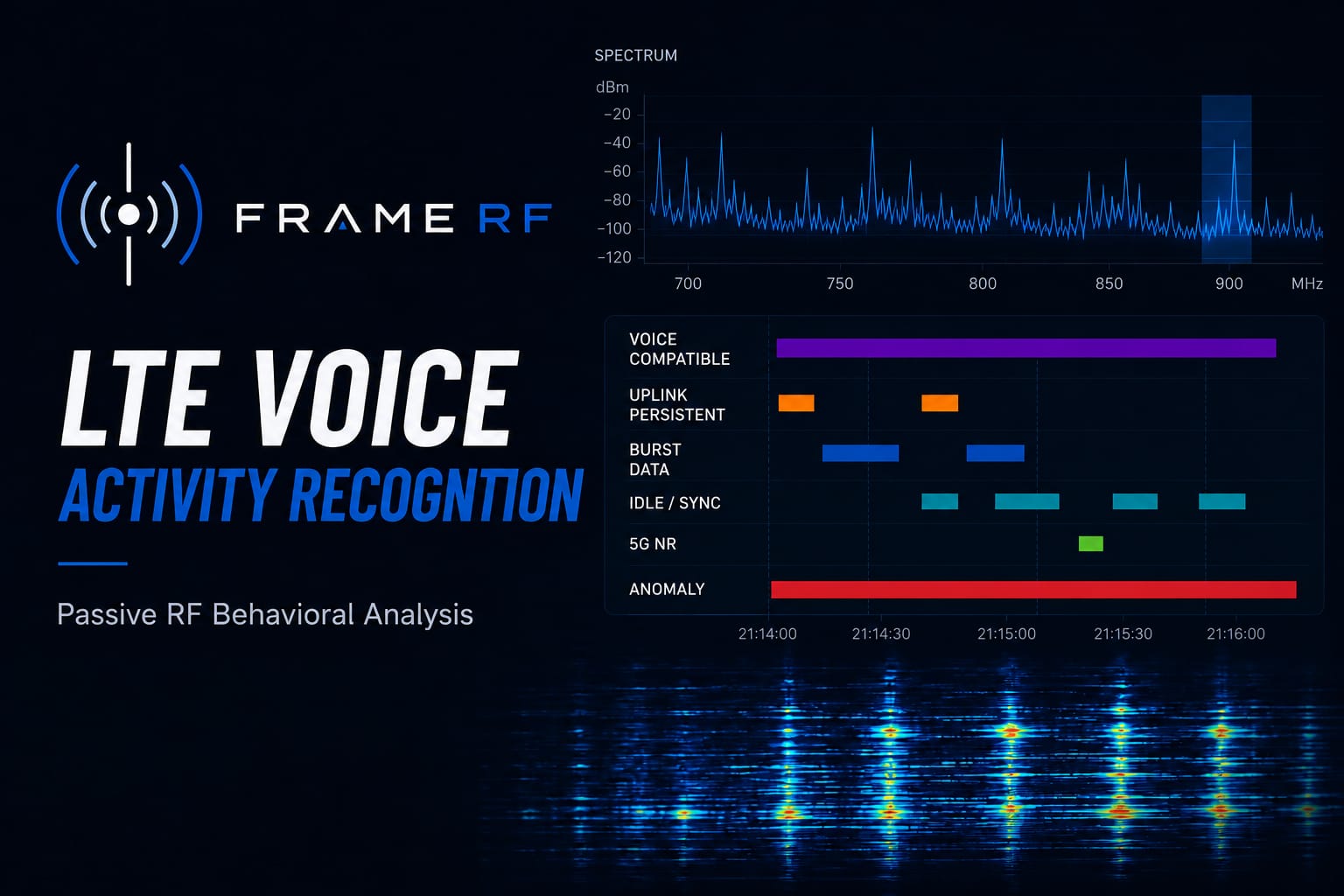
Passive RF Cellular Pattern Analysis for TSCM Operations
The FrameRF Uplink Cellular Plugin is a specialized module designed for passive analysis of cellular uplink activity through behavioral RF pattern recognition.
Unlike traditional interception-based systems, the module does not decode communications and does not rely on IMSI catching techniques.
The objective is to help operators identify and interpret:
- voice-compatible RF activity
- persistent uplink transmissions
- LTE data bursts
- idle/sync cellular signaling
- temporal RF correlations
- anomalous transmission continuity
inside real-world RF environments.
Built from Real Operational Experience
The plugin derives from direct field experimentation and operational RF analysis workflows developed during real TSCM and technical surveillance investigations.
The philosophy behind the system is simple:
modern surveillance technologies often hide inside legitimate RF environments.
For this reason, simple “signal detection” is no longer sufficient.
FrameRF introduces a pattern-based approach capable of evaluating:
- transmission duration
- burst density
- continuity
- temporal persistence
- RF stability
- uplink behavior over time
without decoding content.
Core Functionalities
Passive LTE Uplink Analysis
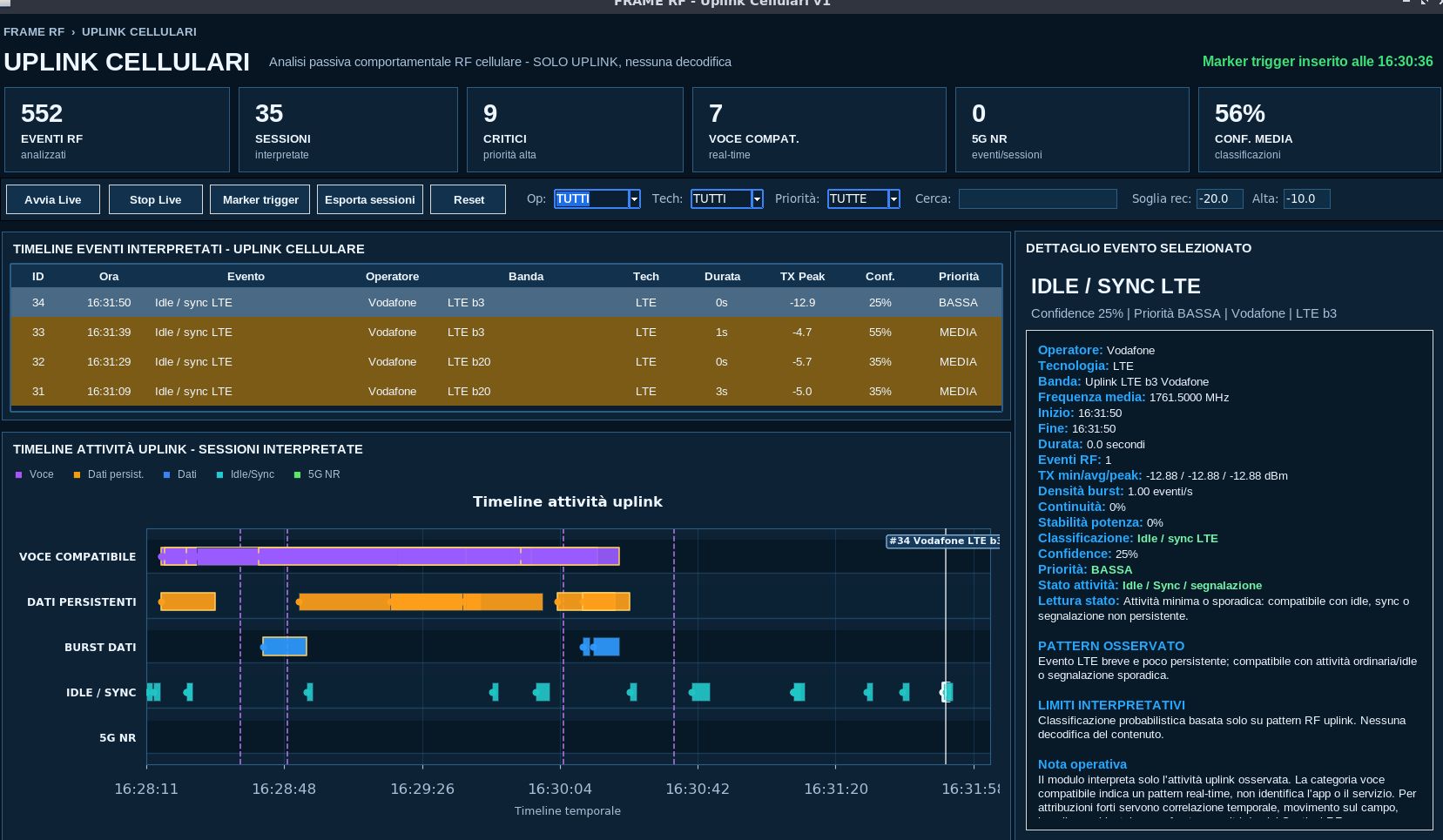
The module continuously analyzes LTE uplink activity and organizes events into interpreted behavioral sessions.
Supported categories include:
- Voice Compatible LTE
- Persistent Data Activity
- Burst Data Activity
- Idle / Sync LTE
- 5G NR activity
The analysis is probabilistic and pattern-based.
No payload interception is performed.
Voice-Compatible RF Recognition
One of the main objectives of the plugin is the identification of RF patterns compatible with real-time voice activity.
The system evaluates:
- continuity
- power stability
- burst timing
- uplink persistence
- session duration
to determine whether a transmission is behaviorally compatible with:
- VoLTE activity
- voice-app traffic
- persistent bidirectional communication
without identifying the application or decoding the communication itself.
Session-Based RF Interpretation
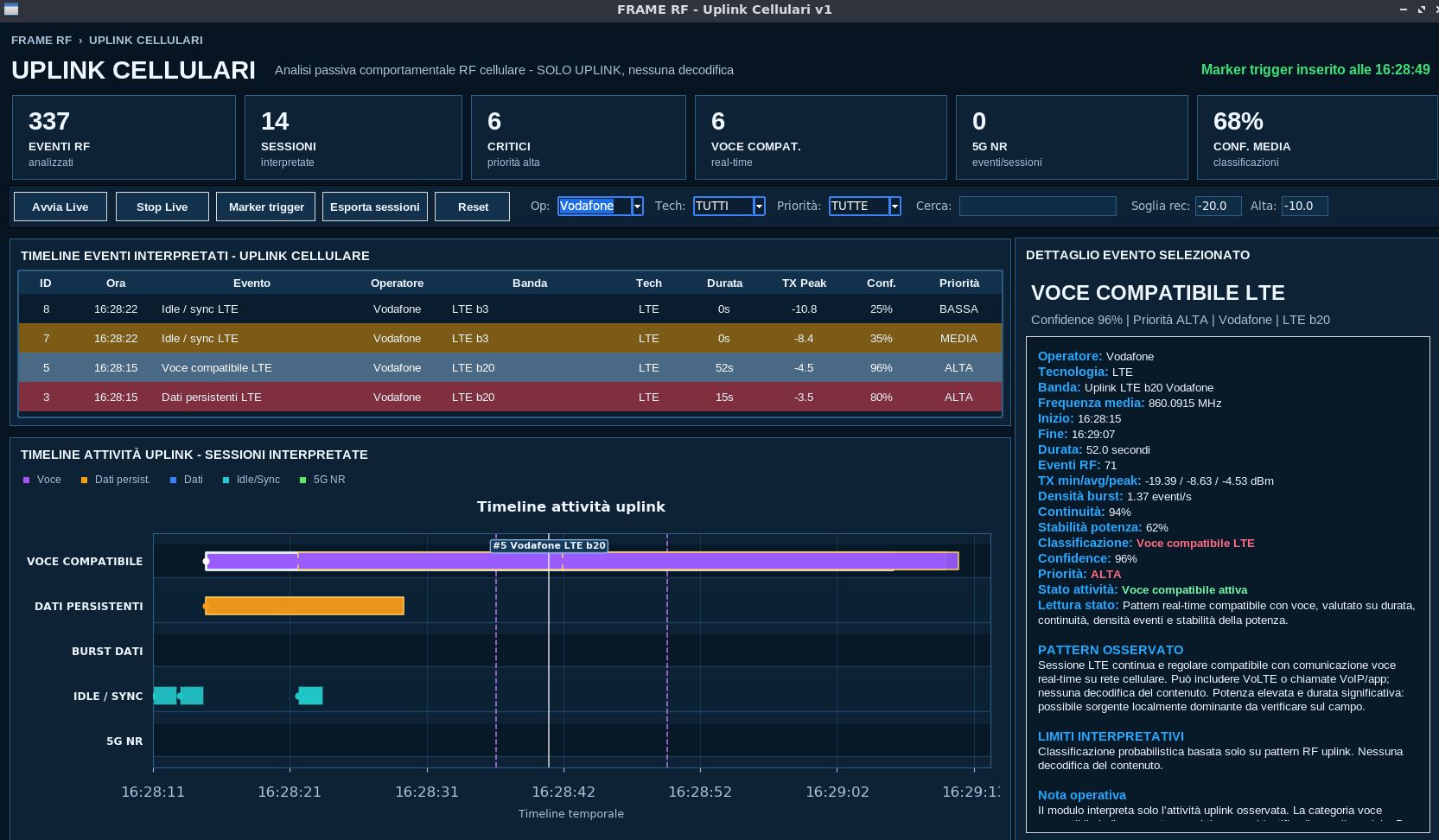
Each interpreted session includes:
- operator association
- LTE band identification
- TX power statistics
- burst density
- continuity scoring
- confidence evaluation
- temporal timeline reconstruction
The operator can inspect every session individually through an interactive detail panel.
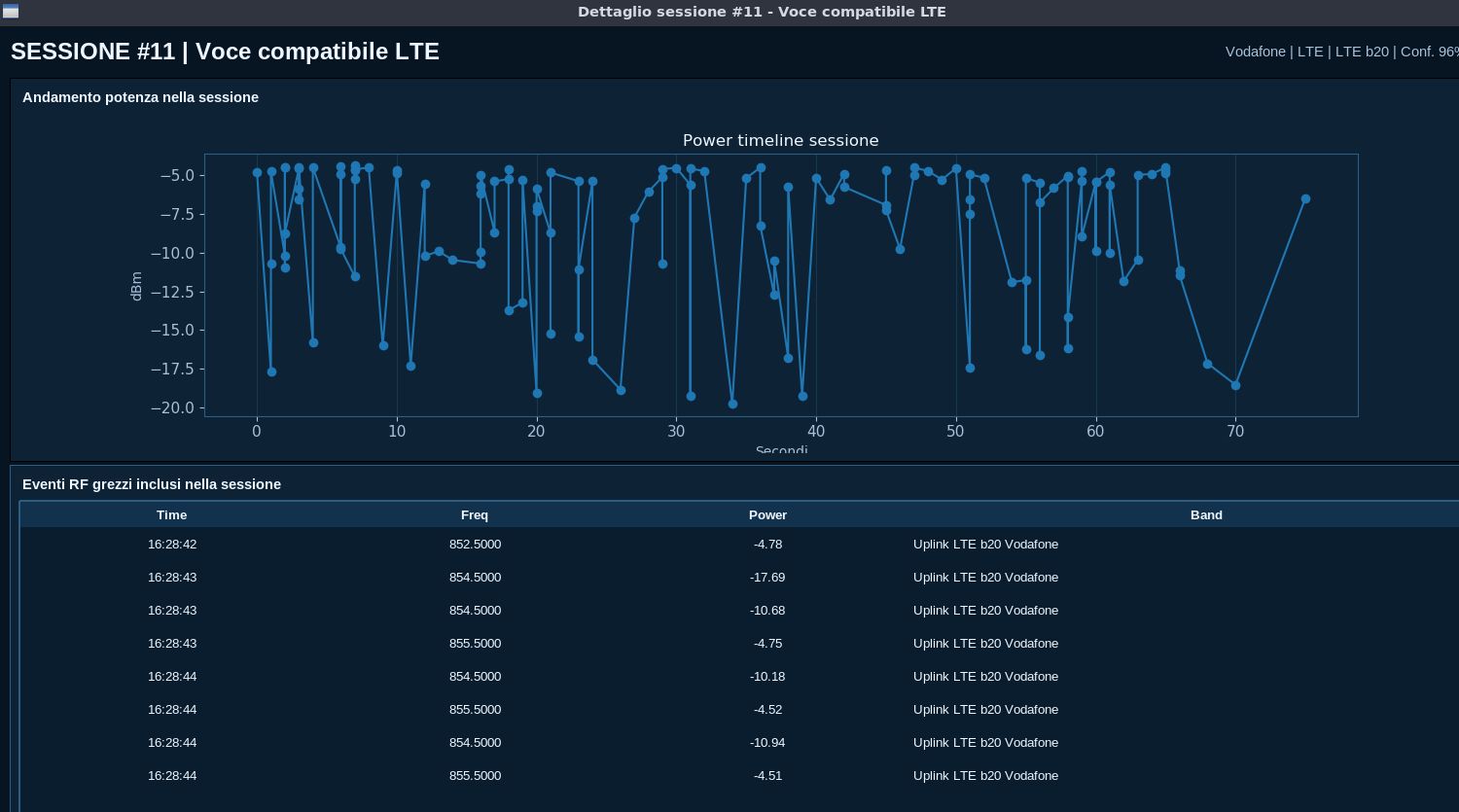
Interactive RF Timeline
The plugin includes a real-time RF activity timeline designed to visually separate different behavioral categories.
The timeline allows operators to quickly distinguish:
- sporadic signaling
- short bursts
- persistent transmissions
- long voice-compatible sessions
- anomalous continuity patterns
during live analysis and post-analysis review.
Pattern-Centric TSCM Philosophy
FrameRF does not attempt deterministic attribution.
The platform focuses on reducing uncertainty by correlating:
- RF behavior
- temporal persistence
- signal continuity
- environmental consistency
- operator/band context
inside operational TSCM workflows.
This approach is particularly useful when dealing with:
- dense RF environments
- modern LTE infrastructures
- uplink-dominant transmissions
- suspected covert wireless activity
- rapid field operations
Passive-Only Architecture
The plugin operates in passive mode only.
Features intentionally excluded:
- IMSI catching
- communication interception
- payload decoding
- audio reconstruction
- message extraction
The module analyzes RF behavior exclusively.
LTE Traffic Recognition Demonstration
This video demonstrates the FRAME RF Cellular Plugin identifying LTE uplink activity through passive RF analysis.
The system does not decode communications and does not intercept content. Instead, it analyzes RF behavioral patterns such as transmission continuity, event density, persistence and temporal activity to classify cellular traffic compatible with LTE data transmissions.
The objective is to support RF/TSCM operators by providing a structured interpretation of observed uplink activity while reducing operational uncertainty during field analysis.
Technical Notes
- Passive RF analysis only
- No communication decoding
- LTE uplink behavioral analysis
- Real-time RF timeline
- Multi-session interpretation
- Designed for operational TSCM environments
- Built around pattern recognition logic
CONTACT
Stefano Cangiano
Independent Researcher – Cyber Security & TSCM Specialist
📧 stefanocangiano91@gmail.com
🌐 stefanocangiano.it
Lascia un commento