
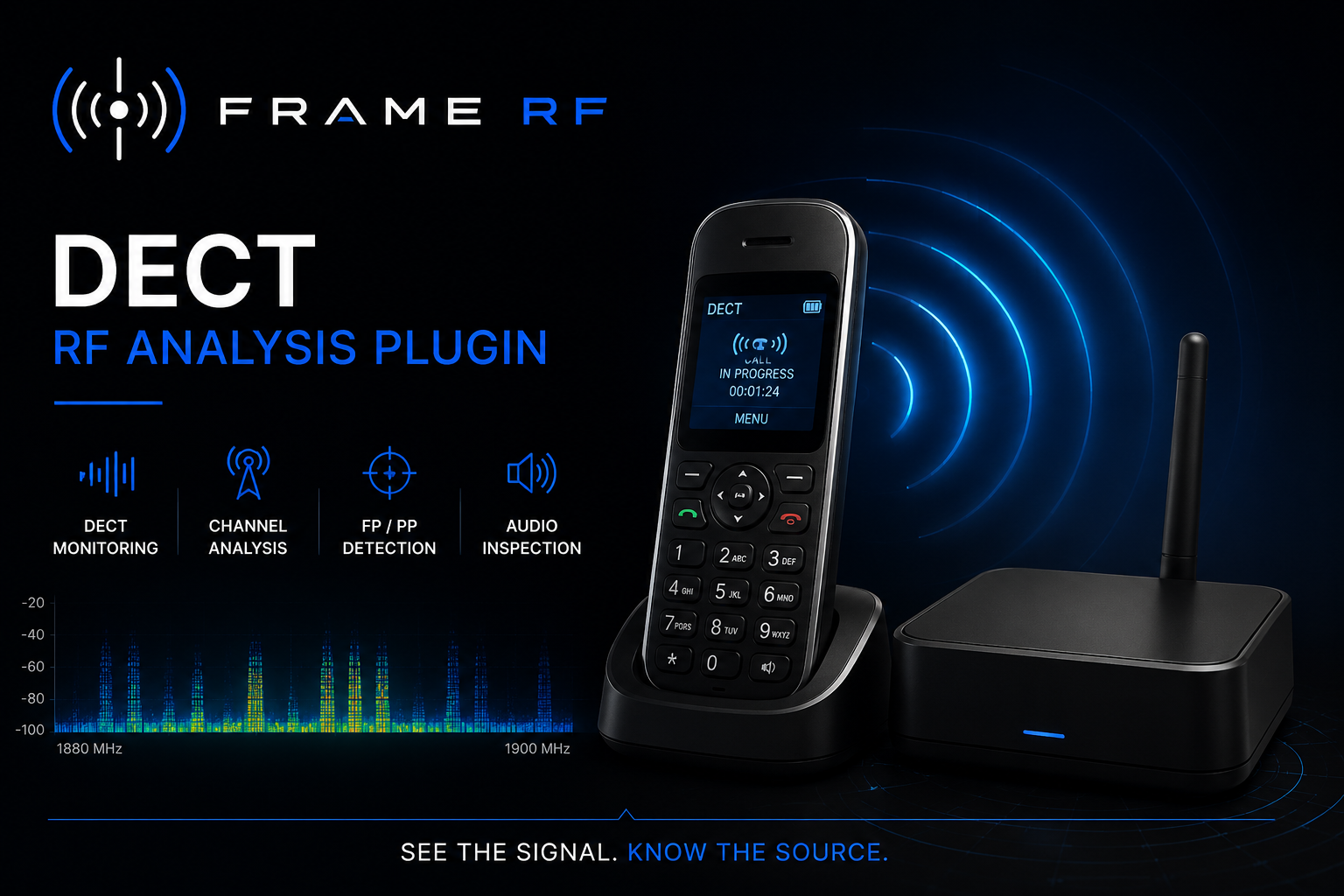
DECT RF Monitoring, Channel Analysis and Audio-Compatible Signal Inspection
The FrameRF DECT Plugin is designed to support technical analysis of the 1880–1900 MHz DECT band, commonly used by cordless phones, wireless base stations and compatible DECT devices.
The module combines:
- RF activity monitoring,
- channel analysis,
- FP / PP identification,
- DECT traffic inspection,
- audio-compatible signal monitoring,
- operational alerting,
- automated reporting.
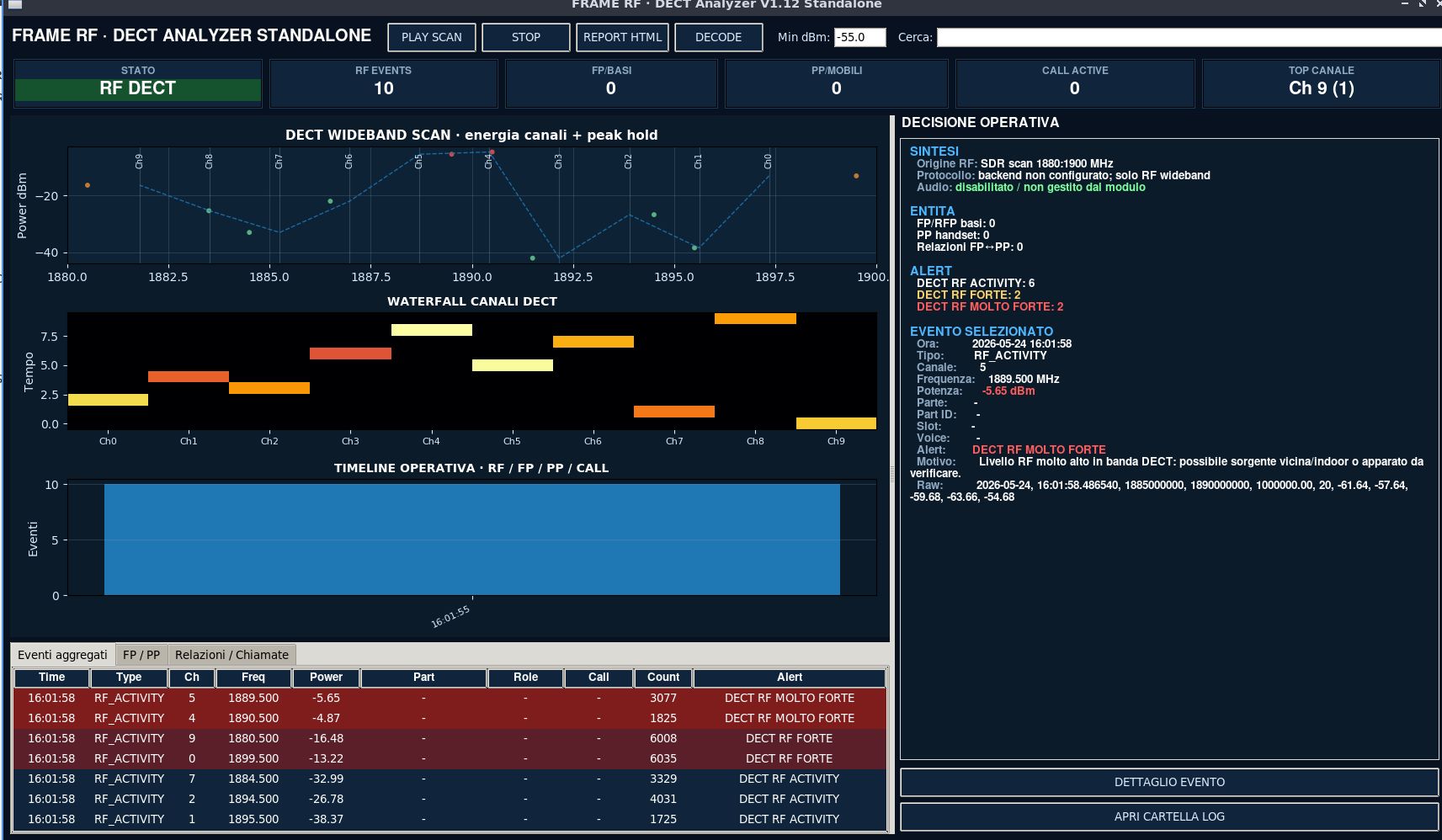
Wideband DECT RF Analysis
The plugin continuously scans the DECT spectrum and provides real-time visualization of:
- active channels,
- detected frequencies,
- signal power levels,
- persistent RF activity,
- dominant channels,
- abnormal RF peaks,
- live RF events.
The interface includes:
- DECT waterfall visualization,
- channel occupancy analysis,
- operational timelines,
- aggregated event tables,
- live monitoring panels,
- RF activity statistics.
Operational Video Demonstration
The following video demonstrates the FrameRF DECT Plugin during a real RF analysis session.
The demonstration may include:
- live DECT band monitoring,
- RF activity detection,
- channel occupancy analysis,
- FP / PP identification,
- DECT traffic monitoring,
- audio-compatible signal inspection,
- operational alert generation,
- automated HTML reporting.
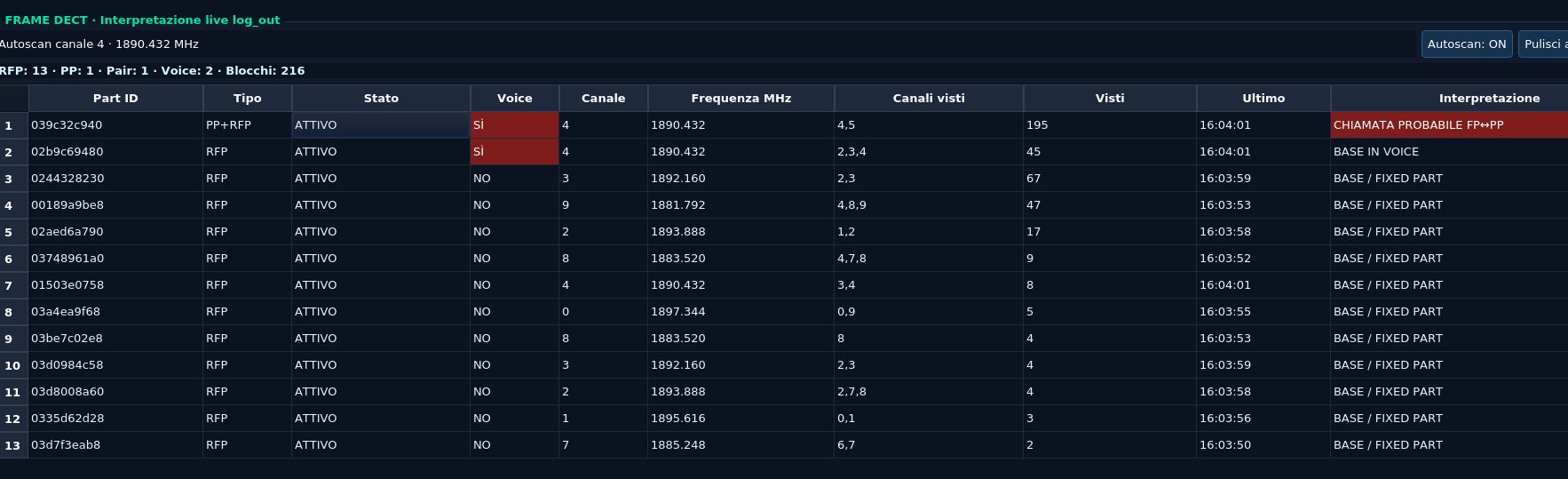
FP / PP Detection and DECT Traffic Analysis
When the DECT backend is available, the module can identify entities compatible with:
- FP / Fixed Parts (base stations)
- PP / Portable Parts (handsets)
- FP–PP relationships
- active DECT traffic
- possible voice sessions
Unlike simple spectrum visualization tools, the plugin can analyze DECT protocol activity and identify communication structures inside the DECT environment.
This allows operators to distinguish:
- idle DECT infrastructure,
- active handset communication,
- persistent cordless activity,
- nearby DECT devices,
- possible local communication sources.
Audio-Compatible Monitoring
The plugin can also monitor DECT audio-compatible transmissions.
If audio is transmitted in clear mode, the communication may be audible.
If encryption is enabled, the output generally appears as digital noise or non-interpretable audio.
In modern environments, most cordless DECT systems use encrypted communication, meaning intelligible audio is typically unavailable.
The objective of the plugin is not communication interception, but technical analysis of DECT activity, transmission behavior and RF persistence.
Operational Logic
The DECT plugin does not provide deterministic attribution.
Its purpose is operational RF support through signal behavior analysis.
For example:
- weak signals may indicate environmental activity;
- strong signals may indicate nearby devices;
- very strong signals may indicate local indoor sources;
- persistent DECT traffic increases operational relevance;
- active FP / PP relationships may indicate ongoing communication activity.
In real-world TSCM operations, RF data must always be correlated with environmental context, physical inspection and operator evaluation.
Alerts and Classification
The module generates operational alerts such as:
- DECT RF ACTIVITY
- DECT RF STRONG
- DECT RF VERY STRONG
- FP DETECTED
- PP DETECTED
- VOICE / AUDIO ACTIVITY
- PERSISTENT DECT ACTIVITY
The alerting system is designed to help operators rapidly focus attention on meaningful RF activity while reducing unnecessary false positives.
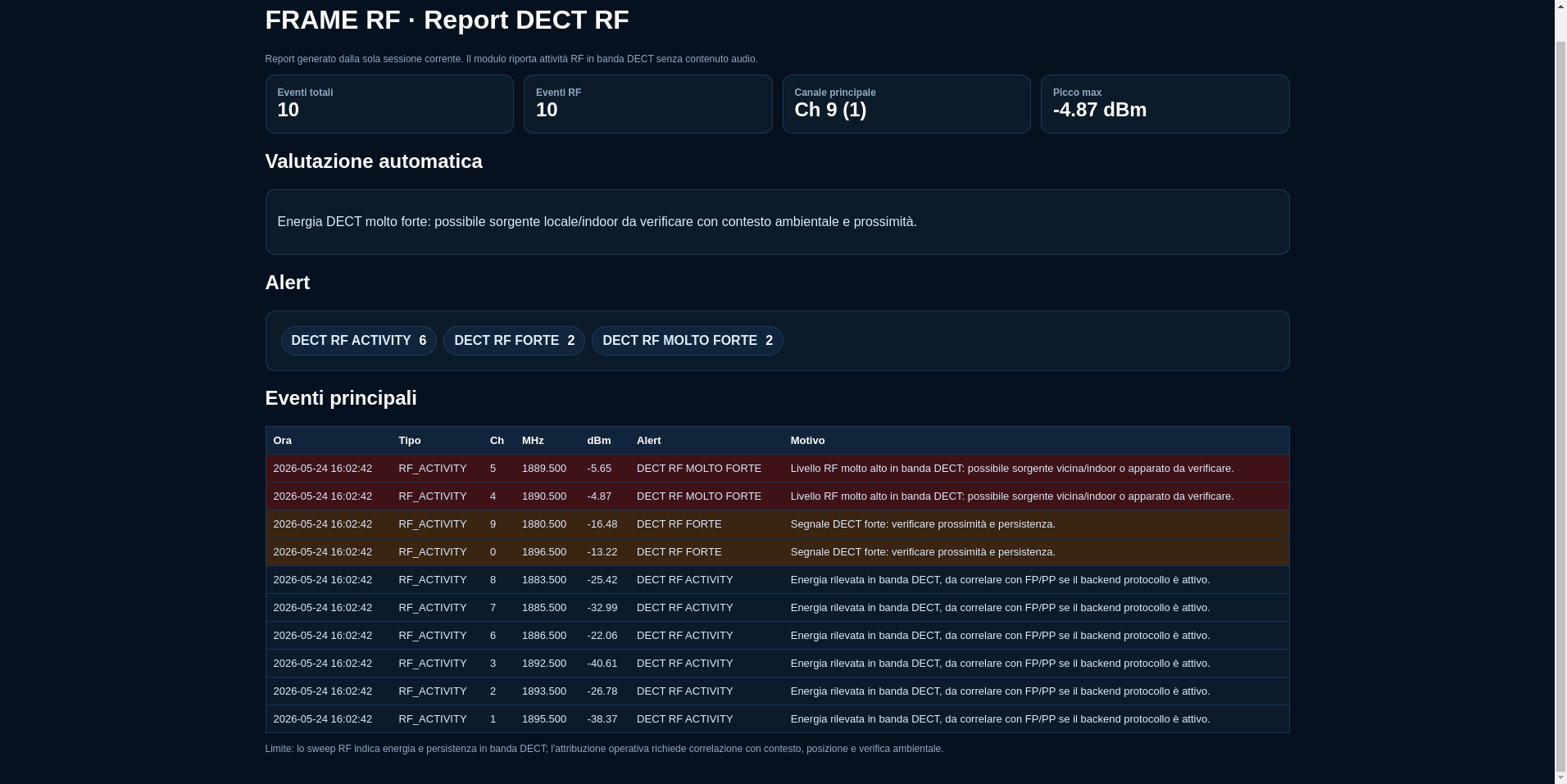
HTML Reporting
The plugin automatically generates HTML reports including:
- total detected events,
- DECT activity summaries,
- dominant channels,
- peak signal levels,
- FP / PP information,
- RF alert summaries,
- technical operational notes.
The reporting system is intended to document operational sessions and support post-analysis review.
Intended Use Cases
The DECT Plugin can support:
- technical surveillance countermeasures (TSCM),
- indoor RF inspections,
- cordless phone activity analysis,
- DECT base station identification,
- persistent RF source analysis,
- suspicious wireless activity investigations,
- operational monitoring of the 1880–1900 MHz band.
FrameRF follows a pattern-based operational approach focused on RF behavior, signal persistence and communication structure analysis.
Conclusion
The DECT Plugin extends FrameRF with dedicated capabilities for one of the most commonly overlooked RF environments in technical surveillance operations.
By combining RF scanning, DECT traffic inspection, FP / PP analysis, audio-compatible monitoring, operational alerts and automated reporting, the module helps operators analyze DECT activity and evaluate its operational relevance within real-world environments.
Stefano Cangiano
stefanocangiano.it
contact: stefanocangiano91@gmail.com
Lascia un commento