
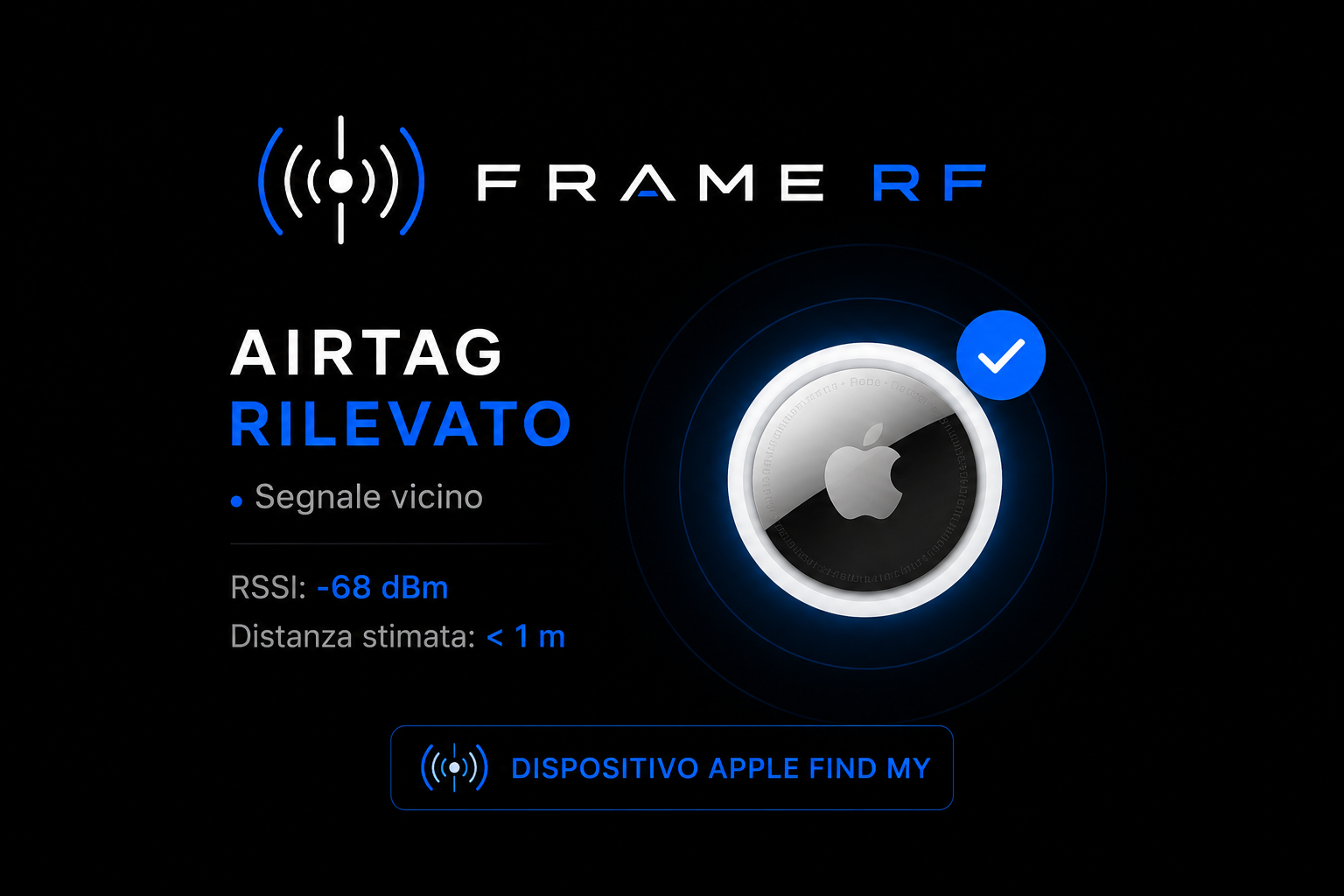
Passive Bluetooth/BLE Intelligence for TSCM Operations
The Bluetooth Intelligence Module for FRAME RF is designed to support passive Bluetooth and BLE reconnaissance during technical surveillance countermeasure (TSCM) activities, environmental inspections, and RF proximity analysis.
Unlike generic Bluetooth scanners focused only on device discovery, this module is built around operational visibility, signal persistence analysis, proximity estimation, and contextual classification of Bluetooth targets detected inside the environment.
The system performs continuous passive acquisition using standard Linux/BlueZ components and transforms raw Bluetooth activity into a structured operational view suitable for real-world field operations.
Operational Philosophy
The module does not claim deterministic attribution or automatic identification of malicious devices.
Instead, it applies a pattern-oriented analytical model based on:
- RSSI persistence
- Device stability over time
- Bluetooth advertising behavior
- Vendor correlation
- Device class inference
- Proximity estimation
- Environmental context
The objective is to reduce uncertainty during live inspections by highlighting devices whose behavior may deserve additional verification.
This approach follows the same philosophy used throughout the FRAME RF ecosystem:
interpret technical patterns, not assumptions.
BLE + Classic Bluetooth Acquisition
The module supports simultaneous acquisition of:
- Bluetooth Classic
- BLE (Bluetooth Low Energy)
- Advertising beacons
- Passive nearby device discovery
The operator can switch acquisition modes directly from the interface.
Supported operational modes include:
- BLE only
- Classic only
- BLE + Classic combined
Device Classification Engine
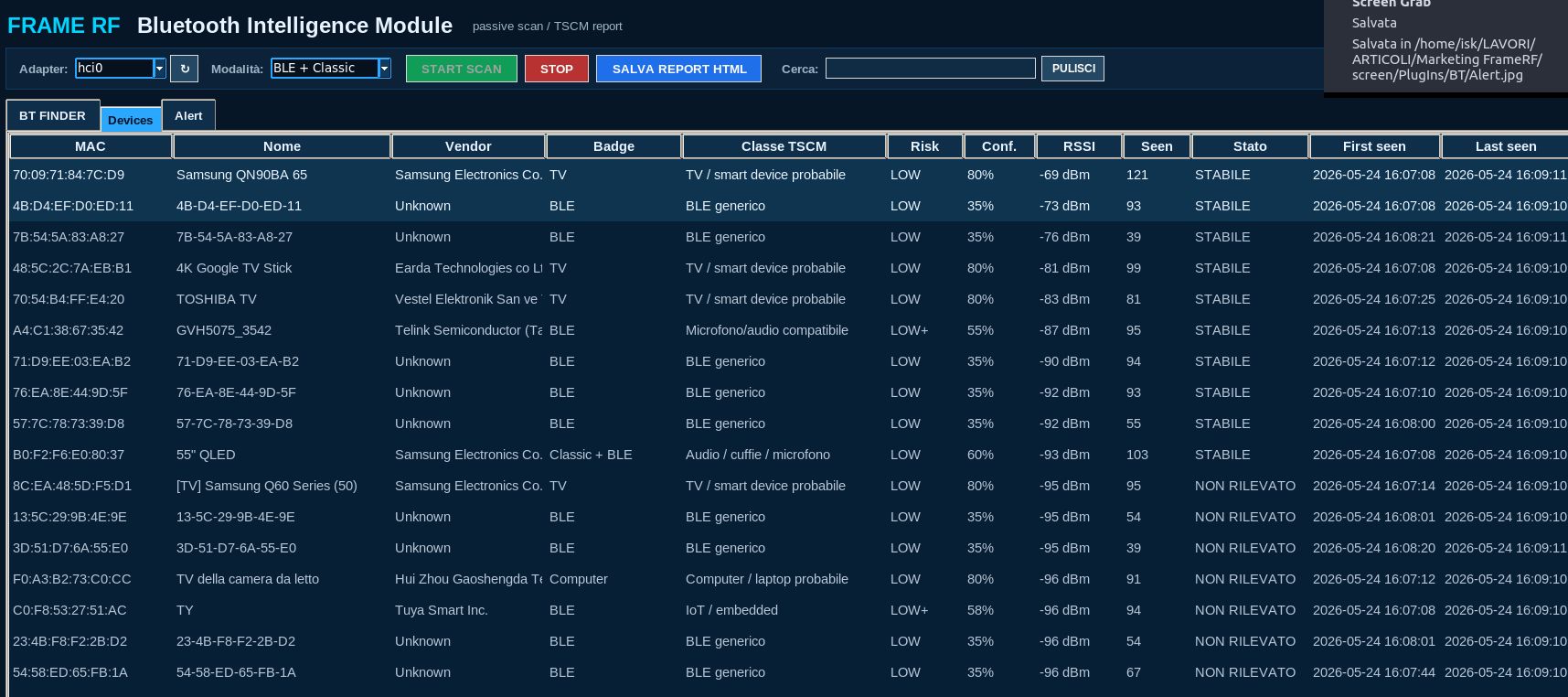
Detected targets are automatically categorized into operational classes.
Examples include:
- TV / Smart device probable
- Audio / cuffie / microfono
- BLE generic
- IoT / embedded
- Computer / laptop probable
- Tracker-compatible devices
- Unknown BLE devices
The classification engine combines:
- Vendor OUI analysis
- Bluetooth device name
- Advertising characteristics
- Presence duration
- Signal behavior
This allows the operator to immediately separate probable consumer devices from anomalous or non-contextual targets.
Proximity Finder Interface
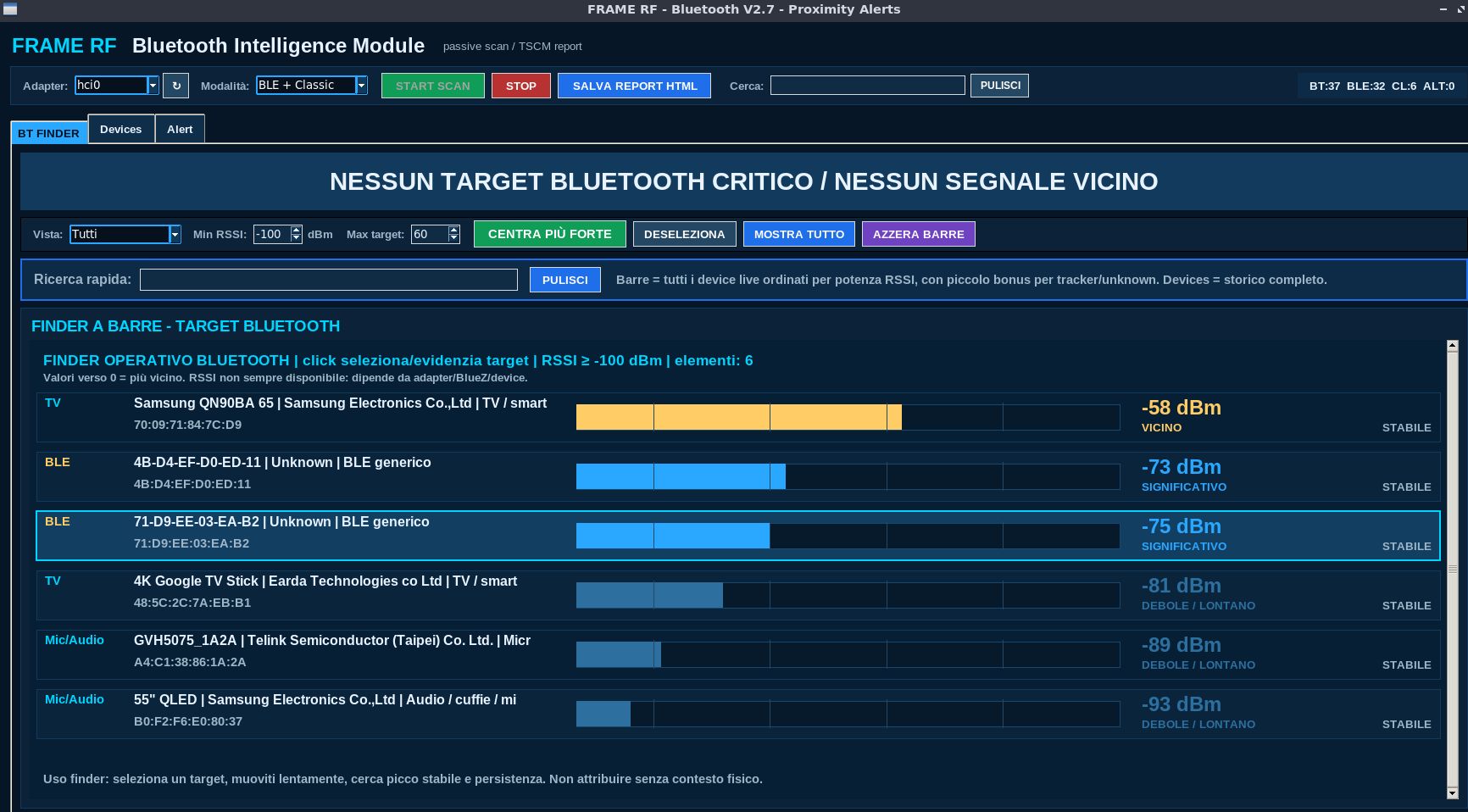
One of the core components of the module is the live Bluetooth proximity finder.
The finder visualizes nearby devices through dynamic RSSI bars ordered by signal strength and persistence.
The interface is optimized for rapid physical movement during inspections.
The operator can:
- center on strongest targets
- filter by RSSI threshold
- isolate unknown devices
- highlight persistent signals
- quickly identify nearby emitters
The system is intentionally designed for operational readability rather than consumer aesthetics.
Signal Persistence & Stability Analysis
The module continuously tracks:
- first seen
- last seen
- persistence
- number of observations
- signal stability
This enables differentiation between:
- transient environmental noise
- moving devices
- persistent local emitters
- stable nearby Bluetooth sources
Persistent and stable signals generally deserve more attention during TSCM verification activities.
Alert System
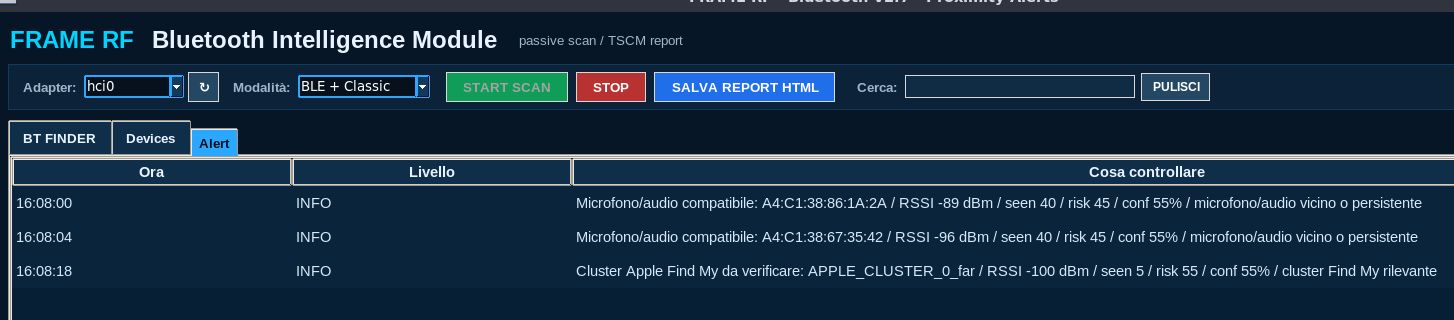
FRAME RF includes an operational alert layer designed to assist the operator during live acquisition.
The system can generate contextual warnings such as:
- microphone/audio compatible devices nearby
- persistent BLE devices
- Apple Find My compatible clusters
- unknown BLE emitters with stable RSSI
- suspicious proximity conditions
Alerts are not deterministic evidence of compromise.
They represent technical indicators requiring contextual interpretation by the operator.
Apple Find My Cluster Detection
The module includes preliminary identification logic for Bluetooth advertising patterns compatible with Apple Find My ecosystems and similar tracker-oriented infrastructures.
The objective is not attribution but contextual awareness.
Detected clusters are highlighted for manual verification when characteristics such as:
- persistence
- repeated advertising
- proximity
- non-contextual presence
appear operationally relevant.
HTML Reporting Engine
The Bluetooth module can generate complete standalone HTML reports directly from the acquisition session.
Generated reports include:
- operational summary
- detected device inventory
- alert timeline
- RSSI information
- vendor classification
- persistence metrics
- confidence estimation
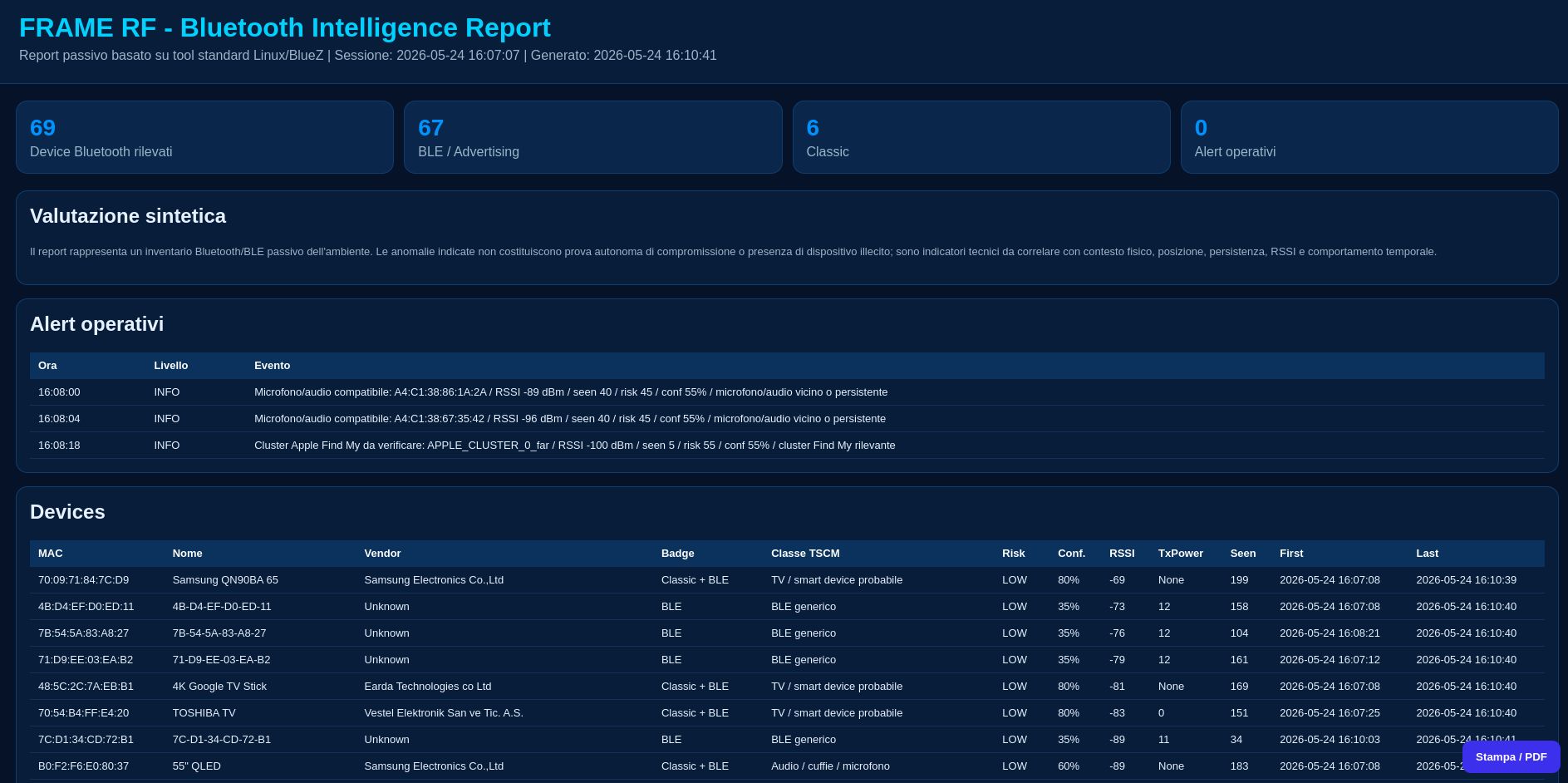
Reports are designed for:
- technical documentation
- investigative archiving
- operational review
- client delivery
The interface maintains the same dark-blue FRAME RF visual language used across the platform.
Technical Characteristics
Core Functions
- Passive Bluetooth acquisition
- BLE advertising analysis
- RSSI-based proximity visualization
- Device persistence tracking
- Vendor/OUI classification
- Apple Find My compatible detection
- Operational alert system
- HTML reporting
- Live filtering and search
- Stability analysis
Design Philosophy
The Bluetooth Intelligence Module is not intended to replace professional RF investigation methodology.
It acts as an operational support layer capable of accelerating environmental interpretation during:
- TSCM inspections
- RF sweeps
- technical reconnaissance
- proximity verification
- live operational analysis
The value of the module is not the Bluetooth scan itself.
The value lies in the operational interpretation layer built from direct field experience, real-world testing, and multidomain RF analysis workflows integrated into the FRAME RF ecosystem.
FRAME RF Ecosystem
The Bluetooth Intelligence Module is part of the modular FRAME RF architecture.
Other modules include:
- Cellular Intelligence
- Wi-Fi Intelligence
- DECT Analysis
- Broadcast RF Analysis
- Spectrum Correlation
- Multidomain TSCM Reporting
Each module is designed to work both independently and as part of a unified RF intelligence workflow.
Stefano Cangiano
stefanocangiano.it
Lascia un commento